Content note: This post discusses sexual violence, lynching, and racial terror. Please take care of yourself as you read.
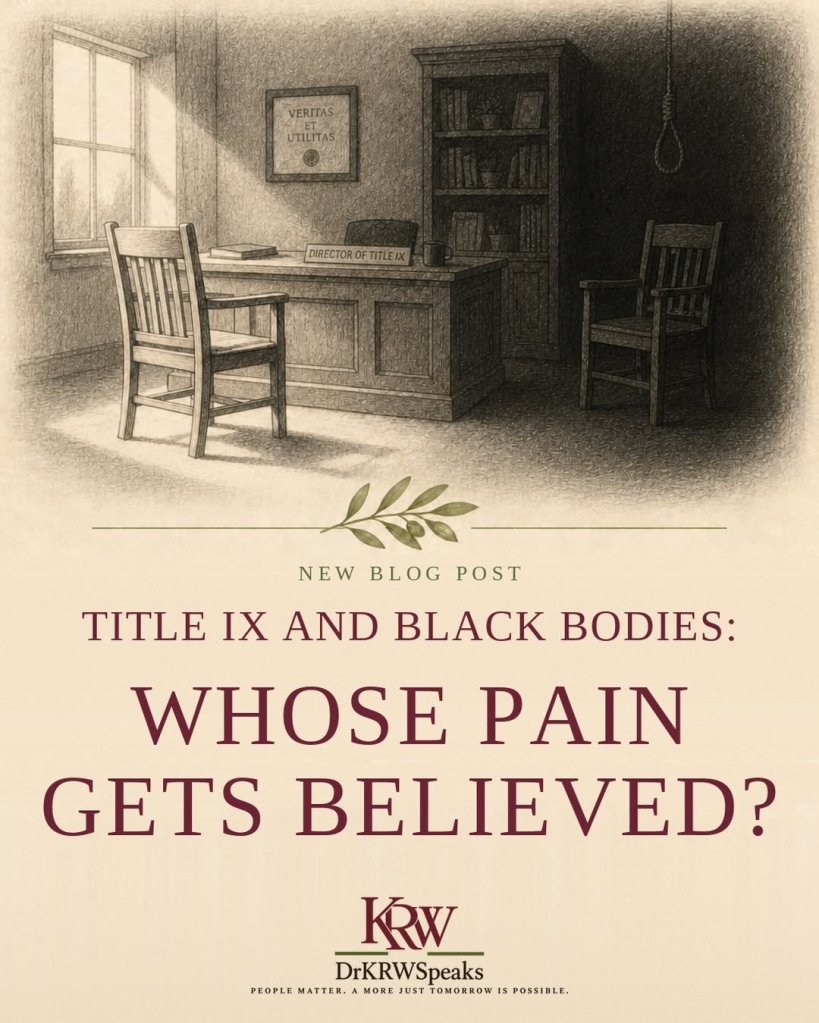
This fall, the country has watched the “Cornell 7” case unfold. A former Cornell University student, identified in court filings as Jane Doe, alleges that members of the Chi Phi fraternity gang-raped her in October 2024. In September 2026, she filed a civil lawsuit against the university and seven current and former students, all of whom deny wrongdoing (Jeyaretnam, 2026). Thousands of people posted #IAmJaneDoe in solidarity. Students protested. Governor Kathy Hochul appointed Attorney General Letitia James as special prosecutor. Cornell’s Title IX panel expelled two of the men, while others received reflection papers and training. The public demanded to know why (Jeyaretnam, 2026). That outrage is earned. Jane Doe deserves every bit of it.
During the same weeks, another story surfaced. Kendall Francis, a first-generation student at Louisiana State University, posted on TikTok that she had been sexually assaulted in an LSU residence hall in October 2025 (Robinson, 2026). LSU’s Title IX office found football player Damien Shanklin responsible for forcible rape in July 2026 and suspended him for two semesters. In August, an administrative law judge reduced the sanction to four semesters of probation, calling the suspension “exceedingly harsh,” which allowed him to remain enrolled and on the team (“East Baton Rouge DA,” 2026; Siemaszko, 2026). Francis told reporters she failed both semesters of her first year and lives with severe anxiety. “I don’t think it was fair to me what happened,” she said (Robinson, 2026).
Kendall Francis is a Black woman. The student found responsible is a Black man. Her case received coverage, and the East Baton Rouge Parish District Attorney has since opened a criminal investigation (Siemaszko, 2026). But the national chorus of outrage and the movement didn’t reach the same scale as at Cornell University. No wave of public figures demanding answers. For me, that silence is familiar. It is the kind of regard our society has long given to Black people when they are carrying trauma and harm.
This post is not meant to relitigate either institution’s decisions. It is about how our society decides whose life matters, whose pain is believed, and whose body is presumed guilty. If we want a more equitable and just society, we must understand the historical context woven into the fabric of our society. Understanding these experiences well enough can be the impetus for changing our behavior and expectations.
Where this conversation started for me
In fall 2019, I partnered with a colleague in the field, J. White, to develop a session on Title IX’s impact on Black bodies, which we presented at the Association for Student Conduct Administration conference in 2020 (Williams & White, 2020). Our research consistently pointed to the same conclusion. The historical trauma stitched into the fabric of this country shapes the credibility Black women are given throughout their processes. Even more so, it shapes the ways Black men are cast as the perpetrators of violence, even in situations where they are also victims.
Kimberlé Crenshaw (1991) gave us the language for this decades ago. Black women sit at the intersection of racism and sexism, and systems built around a single axis of identity routinely fail them. Black men face their own version of that failure. To understand either experience in a Title IX office today, we first have to understand how sexual violence has been used in United States history.
Sexual violence as a tool of power
Sexual assault is about power. It is the ability to violate another person in the most intimate way and to strip away their control over their own body. Colonizers wielded that power long before this country had a name. When Africans were stolen, bought, and sold as property to work the land and build the infrastructure of the United States, sexual violence became yet another means of control.
Under slavery, the law refused to recognize Black women as people who could be raped. Enslaved women had no legal standing to refuse their enslavers, and sexual violence against them was rarely recognized as a crime (Freedman, 2013). Children born from that violence, often labeled children of the plantation, became additional property. Enslavers also forced enslaved people to “breed” to further expand their own wealth, as each child could be sold or put to work. Black men were not spared. Historian Thomas Foster (2011) documents the sexual abuse of enslaved men, including forced coupling and violations by enslavers, a history that Black communities have carried in oral tradition under names like “breaking the buck.”
To justify all of this, White society told stories. The Jezebel stereotype painted Black women as hypersexual and insatiable, making them “unrapeable” in the public mind (Pilgrim, 2002). After emancipation, the brute caricature cast Black men as savage predators hunting White women (Pilgrim, 2000). D. W. Griffith’s 1915 film The Birth of a Nation put that caricature on movie screens across the country and helped revive the Ku Klux Klan. These two images did opposite work. One told the nation that Black women could not be victims. The other told the nation that Black men were always the threat. Meanwhile, White womanhood became the most protected identity in the culture.
A long record of lies, terror, and silence
We can trace this through our history, one event at a time.
In May 1866, White civilians and police in Memphis attacked Black neighborhoods for three days. Five Black women later testified before Congress that they had been raped by members of the mob (Rosen, 2009). Their testimony changed nothing.
In 1921, a White woman’s accusation against a Black teenager in a Tulsa elevator sparked the destruction of the Greenwood district, known as Black Wall Street. White mobs killed residents and burned the community to the ground (Oklahoma Commission to Study the Tulsa Race Riot of 1921, 2001). In January 1923, a White woman in Sumner, Florida, alleged that a Black man assaulted her. Residents of nearby Rosewood, a prominent Black town, denied the claim and said she was beaten by a White lover. Despite this opposition and even with their own knowledge of her dalliance, a White mob burned Rosewood and killed its residents, forever removing it from the map (Jones et al., 1993).
In 1931, nine Black teenagers, known as the Scottsboro Boys, were falsely accused of raping two White women on an Alabama train and spent years in prison. Years later, one of the accusers recanted (Carter, 1969). In 1955, 14-year-old Emmett Till was abducted from his great-uncle’s home in Mississippi and murdered after Carolyn Bryant reported that he whistled at and grabbed her. More than 60 years later, Bryant told historian Timothy Tyson (2017) that part of her testimony was untrue. Mamie Till-Mobley’s choice to hold an open-casket funeral forced the country to look at what had been done to her child, adding fuel to the already brewing civil rights movement.
Between 1882 and 1968, 4,743 people were lynched in the United States, of whom 3,446 were Black (NAACP, n.d.). The most common accusation was sexual misconduct toward a White woman. This pattern persisted into my lifetime. In 1989, five Black and Latino teenagers, originally known as the Central Park 5 and now the Exonerated Five, in New York City were convicted of raping a White jogger in Central Park based on coerced confessions and a lack of DNA match. Shortly after their conviction, Donald J. Trump purchased full-page ads calling for their execution. Courts vacated their convictions in 2002 after another man, another serial rapist in jail, confessed (Burns, 2011).
Society has also monetized the Black body. Black women’s bodies are objectified and sold back to us through advertising and fashion. Some have even sought plastic surgery for enhancements such as lip fillers or procedures to alter their overall shape. We also see how they are portrayed in sports. Sports journalist William Rhoden (2006) has compared the way Black athletes are measured, timed, and inspected at events like the NFL Combine to the auction block, where enslaved people were valued for their size, teeth, and strength. This history is recent, and every Black student brings it to a college campus.
What the data say now
The numbers make the cost clear. More than one in five non-Hispanic Black women in the United States have been raped in their lifetimes, and roughly 35% have experienced some form of contact sexual violence (Smith et al., 2017). Among non-Hispanic Black men, 19.4% have experienced contact sexual violence (Smith et al., 2017). Most of this harm never reaches a police officer or a Title IX coordinator. Among college-age women, about 80% of rapes and sexual assaults go unreported to police (Sinozich & Langton, 2014). For Black women, advocates estimate that for every 1 who reports a rape, at least 15 do not (Barlow, 2020).
Why stay silent? Historian Darlene Clark Hine (1989) described a “culture of dissemblance,” a protective silence Black women developed to shield their inner lives from a society that would not protect them. That silence makes sense given research on what happens when Black women speak. In one experimental study, participants judged a Black woman who reported rape as more responsible for her assault and less believable than a White woman describing the same event (Donovan, 2007). The bias starts early. Adults surveyed by the Georgetown Law Center on Poverty and Inequality viewed Black girls as young as five as needing less protection and nurturing and knowing more about sex than White girls of the same age (Epstein et al., 2017). Legal scholar Deborah Tuerkheimer (2017) calls this the “credibility discount” and shows how it falls hardest on women who are already marginalized.
Black men face a different side of the same history. When actor Terry Crews testified before the U.S. Senate Judiciary Committee in 2018 about being groped by a Hollywood executive, much of the public response asked how a strong Black man could be a victim and questioned his sexuality (Crews, 2018). Philosopher Tommy Curry and Ebony Utley (2018) argue that the sexual victimization of Black boys and men is routinely ignored because our culture cannot picture a Black male body as anything but dangerous. On the other side of the process, the data we do have suggest Black men are overrepresented as respondents. At Colgate University in the 2013 to 2014 academic year, Black students made up 4.2% of the student body, yet Black men were accused in 50% of reported sexual misconduct cases and made up 40% of the students formally adjudicated (Yoffe, 2017). Very few campuses collect or publish these numbers at all.
Put those findings side by side, and the picture is hard to ignore. Black women are disbelieved as victims. Black men are presumed to be perpetrators and are disbelieved as victims. Both are harmed by the same story this country has told for 400 years.
What this looks like inside a Title IX process
In my years as a dean of students and conduct administrator, I watched these histories play out in the room. Before a report is ever made, Black students weigh the risk of over-criminalization by police and campus security. Many do not know how the system works or what counts as a Title IX matter. Kendall Francis believed criminal charges would automatically follow LSU’s finding and did not learn otherwise until nothing happened (Robinson, 2026). If students have seen administrators fail to respond to earlier reports, they have little reason to try. They may not find a single culturally competent first responder. For Black LGBTQ+ students, reporting can also mean being outed within their own community.
Once a case is open, the pressure keeps mounting. A Black woman may fear she will not be believed and may also feel ashamed for bringing another Black person into a system with a long record of punishing us. A Black man may ask himself whether this is a modern-day lynching. Both may feel the added weight of explaining their culture to investigators who do not share it, of not wanting to confirm a stereotype, and of managing families who have their own views on what should be handled “in-house.”
During the process, are they connected with advocates who are not only trained in cultural competency but also understand their own ingrained and perceived biases to ensure they are not presuming their credibility based on their perceived salient identities? Even more so, are we able to provide them with resources that connect with them and also calm the concerns of their parents, families and support systems, who may also be navigating these systems for the first time and have a lack of trust within these systems based on their own lived history and that which has been passed down through their DNA?
At the conclusion of the process, Black students are also met with care and healing systems they do not trust, rooted in the history of studies conducted on Black people, such as the Tuskegee experiment. The U.S. Public Health Service’s Tuskegee study withheld treatment from Black men for decades, and it is only one chapter in a longer history of medical exploitation (Washington, 2006). Students navigating pain and trauma are met with a lack of professional assistance or even with professionals who are not culturally competent, leading to their being dismissed.
Federal policy raises the stakes. On September 29, 2026, the U.S. Department of Education formally removed the 2024 Title IX regulations and restored the 2020 rule’s framework, effective immediately (Nolan & Carvalho, 2026). Under that framework, colleges hold live hearings with cross-examination, and outcomes often hinge on which account a decision-maker finds credible. This further creates economic barriers, as students with higher socioeconomic resources can hire paid lawyers with experience in these types of cases, while others may not. Therefore, when credibility is the deciding factor, the credibility discount stops being an abstract idea and becomes the case.
Mattering as the lens
My research is grounded in mattering: the sense that we matter to other people. Rosenberg and McCullough (1981) described mattering as the feeling that others pay attention to us, see us as important, and depend on us. Schlossberg (1989) applied this idea to higher education and argued that students who feel marginal, as though they do not matter, struggle to belong and persist. My dissertation found the same thing among Black men at a predominantly White institution. Feeling that they mattered shaped whether they planned to stay (Williams, 2018).
Re-establishing mattering for victims of Title IX means giving them opportunities to reclaim their power. That makes Title IX one of the clearest tests of whether a campus means it when it says students matter. A student learns more about their place in the institution from how the institution receives a report than from any welcome speech. When Jane Doe’s story sparked a national movement and Kendall Francis’s story sparked comparatively little, Black students everywhere took a lesson from it. So did Black men who have been harmed and never told anyone, because they have seen what happens to men like Terry Crews when they do.
In order to build a more equitable and just environment for our college students, it is important that we are truly paying attention to these types of situations and ways that we are able to continue the conversations within our own campuses, even when the national conversation glosses over or fails to elevate its importance to the equitable heights. Although these may not spark student protests and outrage, our students are paying close attention to the conversations, or lack thereof, and discussing them within their residence halls, faculty spaces, and student organizations, which in turn shapes their judgments about these decisions and the administration of their institution, most notably student affairs staff and Title IX offices.
What we need to do
In order to create a more equitable Title IX process, grounded in mattering, we must all be aware of the gaps in processes that we must address. To assist with this process, below are some proposed ways to begin.
- Train decision-makers on racialized credibility. Generic implicit bias modules are insufficient. Investigators, hearing officers, and appeal officers need to know the Jezebel and brute stereotypes by name, understand the credibility discount, and examine how those images might shape how they interpret a Black complainant’s demeanor or a Black respondent’s threat level.
- Collect and publish disaggregated data. Campuses should track race and gender for complainants, respondents, findings, sanctions, and appeal outcomes, and review those numbers annually. We cannot fix disparities we refuse to count.
- Make sanctions consistent and transparent. Two campuses, two findings of responsibility, and very different public reactions should prompt us to ask whether outcomes depend on who the student is, which team they play for, or which organization they belong to.
- Build culturally competent support for both parties. Hire and retain Black counselors, advocates, and investigators. Increase partnerships and training with community and student organizations that have built relationships and trust within the Black community. Explain the difference between a Title IX process and a criminal report clearly and early, so no student is left believing one leads automatically to the other.
- Protect due process for respondents without sacrificing care for complainants. Fairness for Black men in these processes and belief in Black women come from the same commitment: refusing to let a stereotype do the work that evidence should do.
- Hold our own communities accountable. Our fraternities, sororities, churches, and families must stop asking survivors to stay quiet to protect the community’s image. Being our brother’s keeper, and our sister’s, means we believe, we support, and we call harm what it is, even when the person who caused it looks like us.
- Bring the same outrage to every survivor. If you posted #IAmJaneDoe, I am glad you did. Now ask yourself whether you know Kendall Francis’s name, and why or why not.
An institution cannot simply declare that students matter. Mattering is built through attention, importance, and care that students can see and count on. The question for every Title IX office, every campus leader, and every one of us is simple to ask but hard to answer honestly. When a Black woman says she was harmed, does she matter to us? When a Black man is accused or says he was harmed, does he? Until we can answer yes to both, we have work to do.
If you or someone you know has experienced sexual violence, confidential support is available through the RAINN National Sexual Assault Hotline at 800-656-4673 or online.rainn.org.
References
Barlow, J. N. (2020, February). Black women, the forgotten survivors of sexual assault. American Psychological Association. https://www.apa.org/pi/about/newsletter/2020/02/black-women-sexual-assault
Burns, S. (2011). The Central Park Five: A chronicle of a city wilding. Alfred A. Knopf.
Carter, D. T. (1969). Scottsboro: A tragedy of the American South. Louisiana State University Press.
Crenshaw, K. (1991). Mapping the margins: Intersectionality, identity politics, and violence against women of color. Stanford Law Review, 43(6), 1241–1299. https://doi.org/10.2307/1229039
Crews, T. (2018, June 26). Testimony before the U.S. Senate Committee on the Judiciary. U.S. Senate Committee on the Judiciary. https://www.judiciary.senate.gov/download/crews-testimony
Curry, T. J., & Utley, E. A. (2018). She touched me: Five snapshots of adult sexual violations of Black boys. Kennedy Institute of Ethics Journal, 28(2), 205–241. https://doi.org/10.1353/ken.2018.0014
Donovan, R. A. (2007). To blame or not to blame: Influences of target race and observer sex on rape blame attribution. Journal of Interpersonal Violence, 22(6), 722–736. https://doi.org/10.1177/0886260507300754
East Baton Rouge DA launches criminal probe after LSU reduced football player Damien Shanklin’s rape suspension to probation. (2026, October 3). Political.org. https://political.org/2026/10/03/east-baton-rouge-da-launches-criminal-probe-after-lsu-reduced-football-player-damien-shanklins-rape-suspension-to-probation/
Epstein, R., Blake, J. J., & González, T. (2017). Girlhood interrupted: The erasure of Black girls’ childhood. Georgetown Law Center on Poverty and Inequality. https://doi.org/10.2139/ssrn.3000695
Foster, T. A. (2011). The sexual abuse of Black men under American slavery. Journal of the History of Sexuality, 20(3), 445–464. https://doi.org/10.1353/sex.2011.0059
Freedman, E. B. (2013). Redefining rape: Sexual violence in the era of suffrage and segregation. Harvard University Press.
Griffith, D. W. (Director). (1915). The birth of a nation [Film]. Epoch Producing Corporation.
Hine, D. C. (1989). Rape and the inner lives of Black women in the Middle West: Preliminary thoughts on the culture of dissemblance. Signs, 14(4), 912–920. https://doi.org/10.1086/494552
Jeyaretnam, M. (2026, October 5). ‘Cornell 7’ case renews scrutiny of fraternities. TIME. https://time.com/article/2026/10/05/cornell-university-sexual-assault-allegations-fraternity-jane-doe-lawsuit/
Jones, M. D., Rivers, L. E., Colburn, D. R., Dye, R. T., & Rogers, W. W. (1993). A documented history of the incident which occurred at Rosewood, Florida, in January 1923. Florida Board of Regents.
NAACP. (n.d.). History of lynching in America. https://naacp.org/find-resources/history-explained/history-lynching-america
Nolan, J. J., & Carvalho, A. L. (2026, September 29). Education Department formally repeals 2024 Title IX rule. Holland & Knight. https://www.hklaw.com/en/insights/publications/2026/09/education-department-formally-repeals-2024-title-ix-rule
Oklahoma Commission to Study the Tulsa Race Riot of 1921. (2001). Tulsa race riot: A report by the Oklahoma Commission to Study the Tulsa Race Riot of 1921.
Pilgrim, D. (2000). The brute caricature. Jim Crow Museum, Ferris State University. https://jimcrowmuseum.ferris.edu/brute/homepage.htm
Pilgrim, D. (2002). The Jezebel stereotype. Jim Crow Museum, Ferris State University. https://jimcrowmuseum.ferris.edu/jezebel/index.htm
Rhoden, W. C. (2006). Forty million dollar slaves: The rise, fall, and redemption of the Black athlete. Crown.
Robinson, P. (2026, September 24). LSU student says university failed her after Title IX finding against football player in sexual assault case. WAFB. https://www.wafb.com/2026/09/24/exclusive-lsu-student-says-university-failed-her-after-title-ix-finding-alleged-sexual-assault/
Rosen, H. (2009). Terror in the heart of freedom: Citizenship, sexual violence, and the meaning of race in the postemancipation South. University of North Carolina Press.
Rosenberg, M., & McCullough, B. C. (1981). Mattering: Inferred significance and mental health among adolescents. Research in Community and Mental Health, 2, 163–182.
Schlossberg, N. K. (1989). Marginality and mattering: Key issues in building community. New Directions for Student Services, 1989(48), 5–15. https://doi.org/10.1002/ss.37119894803
Siemaszko, C. (2026, September 30). LSU student says she was raped by a football player. NBC News. https://www.nbcconnecticut.com/news/national-international/lsu-student-says-she-was-raped-by-a-football-player/3780399/
Sinozich, S., & Langton, L. (2014). Rape and sexual assault victimization among college-age females, 1995–2013 (NCJ 248471). U.S. Department of Justice, Bureau of Justice Statistics.
Smith, S. G., Chen, J., Basile, K. C., Gilbert, L. K., Merrick, M. T., Patel, N., Walling, M., & Jain, A. (2017). The National Intimate Partner and Sexual Violence Survey (NISVS): 2010–2012 state report. National Center for Injury Prevention and Control, Centers for Disease Control and Prevention.
Tuerkheimer, D. (2017). Incredible women: Sexual violence and the credibility discount. University of Pennsylvania Law Review, 166(1), 1–58.
Tyson, T. B. (2017). The blood of Emmett Till. Simon & Schuster.
Washington, H. A. (2006). Medical apartheid: The dark history of medical experimentation on Black Americans from colonial times to the present. Doubleday.
Williams, K. R. (2018). Influence of mattering on Black males’ intent to persist at a regional predominantly White institution [Doctoral dissertation, Texas A&M University–Commerce]. ProQuest Dissertations and Theses Global.
Williams, K. R., & White, J. (2020). Black bodies and Title IX [Conference session]. Association for Student Conduct Administration Annual Conference.
Yoffe, E. (2017, September 11). The question of race in campus sexual-assault cases. The Atlantic.


Leave a Reply