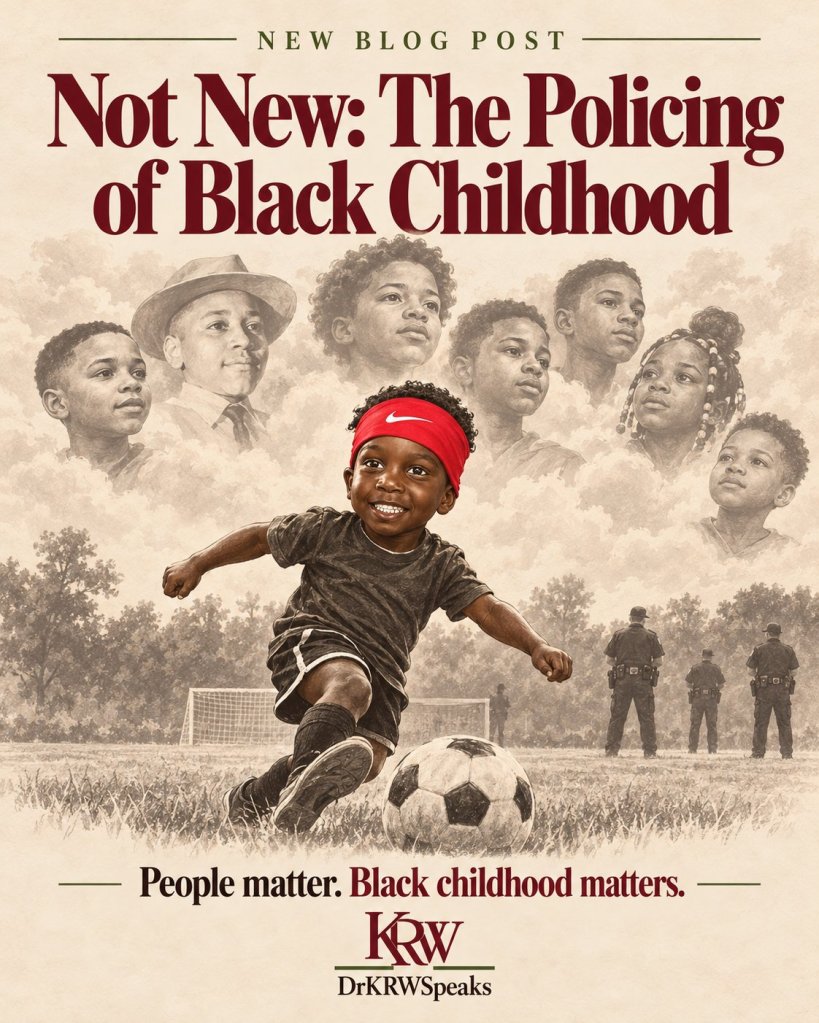
A 3-Year-Old, a Soccer Field, and a 911 Call
This past weekend, we met Nevada. A three-year-old was so talented in soccer that he not only played against children two years older than him, but also became the talk of grown parents and later prompted a call to the Winter Park Police. (“Viral Video,” 2026).
Body camera footage later revealed that the supervising official was amazed by Nevada, calling him “very advanced” to officers, and was astounded by the number of goals he scored, but he also lied, saying, “…he pushes the kids.” Nevada’s mother saw it differently. She says her son was singled out because he “actually played soccer,” while other parents huddled on the sideline talking about him. The league asked the family to leave and offered a refund. Police said no one was arrested and called it a civil matter, and the league says it is reviewing what happened.
Let’s reflect on that a moment. An adult in charge of a program that serves children as young as 3 decided a dispute over a toddler needed to go to law enforcement rather than speaking directly with the mother or even addressing concerns among adults calmly and in a controlled manner. Whatever happened on that field, the grown-ups looked at a preschooler and his family and saw something to police.
Many of us are angry, and honestly, we should be. Yet this isn’t new; it’s learned behavior. This is something that Black families navigate on a daily basis in this country. Our children are watched more closely and disciplined more harshly. People see them as older and more dangerous than they are. Their talent is welcome when it entertains or earns money, and suspect when it outshines another child’s. Black life matters only when it serves someone else’s gain. The rest of the time, Black children are treated as adults, no matter their age.
Nevada’s story is one more entry in a long record. We simply want to exist, and our children deserve the chance to be children and grow up. Researchers have spent more than a decade documenting how rarely they get it.
What the Research Calls It: Adultification
The pattern has a name: adultification. Many researchers and writers have continued to study this and, more importantly, bring it into the open. To support this, I point to Goff et al. (2014), Epstein et al. (2017), and Gilliam et al. (2016), who address this situation directly.
In a study by Goff et al. (2014), researchers asked 264 college students to estimate the ages of boys accused of crimes. Participants overestimated the ages of Black boys between 10 and 17 by an average of 4.5 years, resulting in teenage Black children being perceived as grown men. From age 10 onward, Black boys were judged less innocent and more responsible for their actions, in comparison to their non-Black peers. The same team studied 176 police officers and found that those who unconsciously linked Black people with apes were more likely to have used force against a Black child in custody.
Three years later, a Georgetown Law team published Girlhood Interrupted (Epstein et al., 2017), which found that adults saw Black girls, starting at age 5, as needing less nurturing, protection, support, and comfort than white girls the same age. Participants in this study also viewed Black girls as more independent and as having more knowledge of adult topics, including sex. The widest gaps appeared between ages 5 and 14, the years most of us think of as the heart of childhood.
These biases further affect our classrooms. Gilliam et al. (2016) at the Yale Child Study Center showed 135 early childhood educators short videos of four preschoolers and asked them to watch for challenging behavior. Although none of the clips contained any challenging behavior, eye-tracking revealed that Black children were watched the most, and 42% of participants noted that the Black boy exhibited the most challenging behavior.
Put those findings next to Nevada’s game. Innocence is what lets a child push, cry, show off, break a rule, and be forgiven. That is what latitude means. In this country, innocence gets handed out by race, and Black children start losing it before they can read.
A Childhood That Was Never Allowed
None of this began in a psychology lab. It began in the fields.
The ability of Black children to experience childhood is not ingrained in our Black American society, but the lack of it is inherited. During slavery, Black children did not have a childhood. Historian Wilma King (1995) titled her study of enslaved youth Stolen Childhood for that very reason. Enslaved Black children were young workers, even before the age of ten. They were tasked with carrying water for workers, caring for their younger siblings and the children of the slave owners, and later with joining the work of their own families. They learned early to read white adults’ moods, when to stay quiet, and how to make themselves small, consistently. They had no protected season for play, mistakes, or the slow growth into adulthood. Survival required them not only to act like adults but to become adults long before they were.
The work of Black children was measured in how much money they were able to contribute to the plantation. Berry (2017) explicitly traced the appraisal of Black enslaved people throughout their lives. A Black child’s value to the system came down to labor and sale price, not the child’s humanity.
The culture told a story to match. Bernstein (2011) shows how 19th-century American books, toys, and stage shows defined childhood innocence as white. Black children were portrayed as the “pickaninny,” a caricature depicted as tough, comic, and unable to feel pain. The ability to remove the pain of a Black child further underscores the lack of care, need, and ultimate protection. Therefore, this removes a Black child’s innocence and increases the policing of their body.
The Goff and Georgetown studies picked up that inheritance more than a century later. The fields are gone. The belief that Black children are small adults, built for work and suspicion, stayed.
A Whistle, a Toy, Four Bottles of Water
Black children and the policing of their bodies as adults are ingrained within the very DNA. As you learn the history, the names line up.
In August 1955, 14-year-old Emmett Till left Chicago to visit family in Money, Mississippi. At a country store, Carolyn Bryant, who later admitted to lying, said that Till whistled at her. White men later tracked him down, took him from his family’s home, beat and murdered him, and then tied his dead body to a fan blade and dropped it in the Mississippi River. When Till was found, his body was bloated and unrecognizable. His mother, Mamie Till-Mobley, held an open-casket funeral so the world would see what had been done to her son. A boy was accused of acting like a man, and men killed him for it.
12-year-old Tamir Rice was playing alone outside a recreation center in Cleveland, OH, on November 22, 2014, when a call was placed to the police about him. On the call, the caller could be heard saying that the gun Tamir was carrying was probably a toy and that the person was probably a child. The officers never received this information. Regardless, within seconds of their arrival, an officer shot and killed him. Tamir never got the same benefit as White children who carry toy guns on a daily basis.
On May 28, 2023, Cyrus Carmack-Belton, a 14-year-old Black child, walked into a convenience store in Columbia, South Carolina, and would later not only be murdered but be falsely accused of his own death, a narrative that is often replicated in the killing of Black children. Rick Chow, the store owner, inaccurately suspected Cyrus of stealing four bottles of water (“Columbia Convenience Store Owner,” 2023). As Cyrus left the store, Chow chased him, shooting Cyrus in the back and killing him. On June 1, 2026, a jury found Chow not guilty of murder (CBS News, 2026). A child running away was treated as a threat that had to be stopped.
A whistle. A toy. Four bottles of water. A soccer ball. The details change over 70 years, but the reading does not. Black children are rarely granted the presumption that every child should receive: that whatever they are doing, they are still children.
The Right to Grow Old
All of our children deserve to live, experience life, and grow old, but Black children are not given the same chance. Their dreams, aspirations, hopes, and fears should be cared for, but they weren’t!
On June 14, 2026, we saw the murder of one-year-old Kohen Wiley in Senatobia, Mississippi, after police responded to a shoplifting call over diapers (Pittman & Judin, 2026). His mother, Vellesiya Wiley, says she held him up so the officers could see a child was inside (Sundby, 2026). Officer Hunter Foster fired into the car and killed him. The state says the driver moved toward the officers, and Foster’s lawyer says he had no choice. As of October, neither woman in the car had been charged, and officials had not released evidence of shoplifting (Pittman & Judin, 2026). On October 19, Attorney General Lynn Fitch’s office ruled the use of force justified. Foster resigned days later, and the family’s attorney, Ben Crump, has asked the U.S. Department of Justice to investigate (Sundby, 2026). A baby is dead after a dispute over diapers, and the state’s answer is that the shooting was justified.
Weeks later, over the July 4, 2026 weekend, Nolan Xavier Wells, 18 and barely past childhood, went to Horn Island off the Mississippi coast with three white friends. He was last seen that afternoon, and a park ranger found his body two days later (Ramirez Uribe, 2026). The state medical examiner and an independent pathologist hired by the family both ruled the cause and manner of death undetermined. The state’s autopsy noted a bruise on the back of his head (Schafer, 2026). On September 21, a Jackson County grand jury declined to indict anyone. It found no credible evidence of a crime or a racial motive and said the case should be revisited if new evidence surfaces.
These are just a few names of Black children who have been taken from their families for a multitude of reasons. Regardless of their deaths, these children were policed, killed, and blamed for their own deaths, and their families have to seek justice within legal systems where accountability for the policing and killing of Black bodies is not provided. We must continue to say their names: Kohen, Nolan, Cyrus, Tamir, and Emmett, because they will not grow up. We must continue to push for justice, inclusion, and equality within our systems, because their lives matter!
In the Classroom, It Starts in Preschool
Schools are where most children spend their days, and the data there tells the same story.
Civil Rights Data from the 2021-2022 school year reported that Black children were 18% of public preschool enrollment but 38% of preschoolers who received one or more out-of-school suspensions and 33% of those who were expelled (Najarro, 2025). In K-12, Black boys were 8% of students but 22% of those suspended out of school and 21% of those expelled. The preschool numbers cover 3- and 4-year-olds, the same age as Nevada.
Police have even been called on preschool children. In September 2019, 6-year-old Kaia Rolle had a tantrum at her elementary school in Orlando, just down the road from where Nevada played, after a teacher took her sunglasses (Sonnenberg, 2024). School staff were aware of a sleep condition she had and that it would result in outbursts. Yet actions still occurred that triggered the outburst. When the school resource officer arrived, she was sitting calmly with a coloring book. He still arrested her. A grown man placed a six-year-old, who was knowingly diagnosed with a condition, in zip ties and transferred her to a juvenile assessment center, where she was fingerprinted and processed into the legal system, all without communicating this to the child’s guardian, her grandmother. The officer claimed that she was arrested because she “didn’t listen to him.” This same officer would later arrest an 8-year-old student at the same school. Charges were later dropped, but the emotional and traumatic experience the child faced had already occurred (Sonnenberg, 2024).
In 2021, Florida enacted the Kaia Rolle Act, raising the minimum age for arrest to 7. Her family and the SPLC had pushed for 12. The same SPLC report found that Florida districts with more than three school resource officers per 1,000 students arrest students at more than twice the rate of those with fewer than two, and that Black youth in Florida are moved to adult court at nearly three times the rate of their white peers (Sonnenberg, 2024).
The Georgetown researchers made the connection directly. When adults believe Black girls need less protection and know more than they should, those beliefs translate into harsher discipline and less patience (Epstein et al., 2017). The Yale study shows the same pattern from the other side. When teachers watch Black boys most closely, they find what they expect to see (Gilliam et al., 2016). Surveillance becomes the evidence that justifies more surveillance.
When Black Childhood Is Worth Something to Someone Else
America celebrates Black children in one place: when they win for someone else.
At 15 years old, Dominique Dawes competed in her first Olympics in Barcelona in 1992. Four years later, she was a member of the “Magnificent Seven” that won team gold in Atlanta and became the first Black woman to win an individual Olympic medal in gymnastics. The country cheered. Decades later, she described the world behind those medals as “a very harmful environment, physically, verbally, emotionally,” one that rewarded coaches for abuse (WUSA9, n.d.). She described her experience as a young athlete: “fear and emotional health were completely ignored.” At 12, she confided in a teammate and regretted it, so she stopped telling anyone, including her parents. She remembers hiding in a bathroom during long practices because she was too afraid to try a skill.
In 2012, Gabby Douglas was in London when she became the first Black woman to win the Olympic all-around title, and much of the national conversation focused on her hair. Simone Biles withdrew from events at the Tokyo Games in 2021 to protect her mental and physical well-being, and a large share of the public called her a quitter. While Biles was an adult, the message to the girls watching was the same: your body is for performing, and your pain is an inconvenience.
The Olympic stage is only the most visible version. The same sorting begins on playgrounds and in middle school gyms. Black boys and girls who run fast or jump high get noticed early, and once noticed, they are tracked. Coaches, travel teams, and recruiting services project their value years before they can drive. For many families, especially those shut out of generational wealth, an athletic scholarship looks like the surest way to pay for college. The child’s body becomes the family’s financial plan.
The odds behind that plan are long. Only about 2% of high school athletes earn an NCAA scholarship (Matthews, 2026). Yet the young people who make it carry entire programs. Harper (2018) found that Black men were about 2.4% of undergraduates at Power Five universities but 55% of football players and 56% of men’s basketball players (Brenneman, 2018). Those athletes graduated at just over 55% within six years, behind Black undergraduate men overall (60%), all student-athletes (69.3%), and all undergraduates (76.3%). Scholars have not been shy about making the comparison. Hawkins (2010) titled his book on Black athletes at predominantly white NCAA institutions The New Plantation. The money flows up, and the bodies doing the work are Black and often still teenagers.
That is the echo of the auction block I cannot ignore. As previously mentioned, on the plantation, a Black child’s price was set by how much labor his body could produce (Berry, 2017). Today we call it a recruiting ranking, a star rating, or a scholarship offer. The language is softer, but the question about the child remains the same: what is this body worth, and what can it do for us?
The cost to that body and mind is treated as the price of admission. Injuries are played through. Anxiety and depression are read as weakness. A struggling child is told to stay focused because the scholarship, and maybe the family’s way out, is on the line. Nobody wants to be the adult who slowed down the kid who could make it, so the system becomes so invested in the outcome that it stops seeing the child. The pattern holds after the career ends. In the NFL’s $1 billion concussion settlement, doctors used “race-norming,” which assumed Black players started with lower cognitive function than white players (Dale, 2021). That made it harder for Black retirees to prove brain damage and collect. The league pledged to end the practice in 2021 after Black former players and their families pushed back. From the youth field to retirement, Black bodies are valued for what they produce and discounted when they are hurt.
This is what I mean when I say Black life is allowed to matter only when it is monetized. Medals, scholarships, ticket sales, and television contracts all depend on Black children performing. The children themselves, their fear and their health, come second. It is the logic of the auction block, dressed in red, white, and blue. It explains the soccer field, too. A Black child’s talent is a gift when it wins your team a medal. When it beats your child in a Saturday game, it becomes a reason to call the police.
Skinfolk Ain’t Kinfolk
Our community has a saying, often attributed to Zora Neale Hurston and loosely drawn from her autobiography Dust Tracks on a Road (Hurston, 1942): all my skinfolk ain’t kinfolk. Shared skin does not guarantee shared care. That matters here because adultification is not only something white adults do to Black children.
The Yale preschool study found it in our own home. Black teachers held Black preschoolers to a higher behavioral standard than white teachers did (Gilliam et al., 2016). The researchers speculated that some Black educators may believe Black children need harsh discipline to survive a harsh world. I understand that instinct. Many of us were raised on it by parents and grandparents who knew what happened to Black children who were not careful. But fear handed down as discipline still tells a child he does not get to be a child. And when Memphis police fatally beat Tyre Nichols in January 2023, all five charged officers were Black. A uniform can turn skinfolk into enforcers of the same system.
The saying also names a harder conversation within the diaspora. Black Americans, born of the lineage of the enslaved and those who built the very foundational wealth systems of this country, are often looked down on not only by White individuals but also by immigrants from the Black Diaspora. These immigrants may be from the continent of Africa or from countries in the Caribbean. Regardless, the narratives used against Black Americans describe us as lazy, stuck, and people who complain about racism instead of working. Many Black Americans feel this sting at work, on campuses, in public spaces, in social media posts from Black artists, and in church. That hurt deserves to be said out loud.
What deserves even more attention is how people exploit that tension against us. In 2003, Lani Guinier asked how many of Harvard’s Black students had grown up in the United States and attended public school (Heller, 2004). Massey et al. (2007) quantified the question. Immigrants and children of immigrants were about 13% of Black Americans ages 18 to 19, but 27% of Black students at 28 selective colleges, and about 41% in the Ivy League (Jaschik, 2007). The researchers cited differences such as fathers’ education. Others drew a different lesson: if some Black people succeed, racism must not be the problem, so Black Americans must be. Black immigrant success becomes a tool to dismiss the descendants of the enslaved, much as the “model minority” myth has been used to pit Asian Americans against Black Americans. That comparison erases history. Many immigrants arrive already selected for education and opportunity, and their families did not live through slavery, Jim Crow, and redlining on this soil.
The comparison also fails on its own terms. Police do not ask where a Black child’s parents were born before deciding he looks older. Amadou Diallo was from Guinea, and Botham Jean was from St. Lucia. Adultification reads skin, not passports, and every Black child in this country inherits the same suspicion, regardless of their family’s story. The people who benefit from dividing us are counting on us to forget that.
When we ask who protects Black children, we have to look at our own community, too. Kinfolk is something you choose to be. It shows up in how a Black teacher responds to a 4-year-old’s tantrum, how a Black officer approaches a 12-year-old, and in whether we let anyone turn our differences into evidence against each other.
Seen, but Not Mattering
My research centers on mattering. Rosenberg and McCullough (1981) defined it as the belief that we are the object of someone else’s attention, that we are important to them, and that they depend on us. Schlossberg (1989) extended the idea to higher education, setting mattering against marginality, the feeling of not fitting in and not being missed. My dissertation examined how a sense of mattering shapes whether Black men choose to stay in college (Williams, 2018). That sense does not begin at 18. It is built or broken long before and experienced during transitions.
Adultification does not ignore Black children; it watches them consistently through teachers, coaches, store owners, parents of teammates, and ultimately, justice systems composed of police, judges, medical examiners, and so many others. Our children are watched and observed, but what they fail to receive is care. Seeing Black children as a threat demonstrates the concepts of Mattering and Marginality (Schlossberg, 1989), which discuss the importance of creating spaces of mattering in environments where certain demographics are permanently marginalized. Therefore, being seen as a threat is the opposite of mattering, even when it looks like attention from the outside. A child who is always watched but never protected learns that the adults around him notice him only when he might be a problem or when he might be profitable.
That is the lesson Nevada was taught at age 3. He was seen, all right. He was seen as too good, too strong, too much. The adults on that field failed to see a little boy who loves soccer. His mother had to explain why the people he had been taught would serve and protect him, and stop the bad guys, were called on him when there was no sign of danger and no sign that he was being bad.
So, what do we owe our children? While this experience focuses on Nevada, it’s about more than sports programs; it reflects on our greater society and how we must let all our children experience their innocence and grow. Children learn these tropes and experiences from the adults tasked with teaching them right from wrong, and what it means to fear another human being. Therefore, adults must grow, learn, and challenge these dangerous tropes and experiences for this to happen. We must be clear about when police are called, what they will address, and even push back on this type of behavior that is truly discord and not a truly unsafe civil matter. All schools should track discipline and referrals by race and age, starting in preschool, and act on what the data show. Coaches, teachers, and program directors can be trained to recognize adultification in their decisions and held accountable when it appears. Those of us in higher education can remember that our students arrive carrying 18 years of these messages and build campuses where Black students experience care, not only scrutiny.
We will not undo four centuries of history in a single season. But every adult who chooses to see a Black child as a child is answering that history. Nevada deserves that. So did Emmett, Tamir, Kaia, Cyrus, Nolan, and Kohen. So do all of our children.
References
Bernstein, R. (2011). Racial innocence: Performing American childhood from slavery to civil rights. New York University Press.
Berry, D. R. (2017). The price for their pound of flesh: The value of the enslaved, from womb to grave, in the building of a nation. Beacon Press.
Brenneman, R. (2018, March 11). Black athletes’ graduation rates lag at U.S. universities with top sports teams. USC News. https://today.usc.edu/?p=29075
CBS News. (2026, June 1). South Carolina store owner acquitted of murder in 2023 killing of Black teen wrongly suspected of shoplifting. https://www.cbsnews.com/news/chikei-rick-chow-south-carolina-store-owner-murder-cyrus-belton/
Columbia convenience store owner charged with murder in shooting death of 14-year-old boy. (2023, May 30). WIS News 10. https://www.wistv.com/2023/05/30/columbia-convenience-store-owner-charged-with-murder-shooting-death-14-year-old-boy
Dale, M. (2021, June 2). NFL pledges to halt “race-norming,” review Black claims. WITF. https://witf.org/2021/06/02/nfl-pledges-to-halt-race-norming-review-black-claims
Epstein, R., Blake, J. J., & González, T. (2017). Girlhood interrupted: The erasure of Black girls’ childhood. Georgetown Law Center on Poverty and Inequality. https://www.law.georgetown.edu/news/black-girls-viewed-as-less-innocent-than-white-girls-georgetown-law-research-finds/
Gilliam, W. S., Maupin, A. N., Reyes, C. R., Accavitti, M., & Shic, F. (2016). Do early educators’ implicit biases regarding sex and race relate to behavior expectations and recommendations of preschool expulsions and suspensions? [Research study brief]. Yale University Child Study Center.
Goff, P. A., Jackson, M. C., Di Leone, B. A. L., Culotta, C. M., & DiTomasso, N. A. (2014). The essence of innocence: Consequences of dehumanizing Black children. Journal of Personality and Social Psychology, 106(4), 526–545. https://doi.org/10.1037/a0035663
Harper, S. R. (2018). Black male student-athletes and racial inequities in NCAA Division I college sports: 2018 edition. University of Southern California, Race and Equity Center.
Hawkins, B. (2010). The new plantation: Black athletes, college sports, and predominantly White NCAA institutions. Palgrave Macmillan.
Heller, N. (2004, January–February). People who look like you. Harvard Magazine. https://www.harvardmagazine.com/2004/01/people-who-look-like-you-html
Hurston, Z. N. (1942). Dust tracks on a road. J. B. Lippincott.
Jaschik, S. (2007, January 31). The immigrant factor. Inside Higher Ed. https://www.insidehighered.com/news/2007/02/01/immigrant-factor
King, W. (1995). Stolen childhood: Slave youth in nineteenth-century America. Indiana University Press.
Massey, D. S., Mooney, M., Torres, K. C., & Charles, C. Z. (2007). Black immigrants and Black natives attending selective colleges and universities in the United States. American Journal of Education, 113(2), 243–271.
Matthews, A. L. (2026, September 6). Fall sports are here. See how likely that sport is to take a kid to college. Scripps News. https://www.scrippsnews.com/sports/fall-sports-are-here-see-how-likely-that-sport-is-to-take-a-kid-to-college
Najarro, I. (2025, January 16). What the latest civil rights data show about racial disparities in schools. Education Week. https://www.edweek.org/leadership/what-the-latest-civil-rights-data-show-about-racial-disparities-in-schools/2025/01
Pittman, A., & Judin, N. (2026, October 19). Police shooting of 1-year-old Kohen Wiley “was justified,” Mississippi attorney general says. Mississippi Free Press. https://www.mississippifreepress.org/police-shooting-of-1-year-old-kohen-wiley-was-justified-mississippi-attorney-general-says/
Ramirez Uribe, M. (2026, July 10). What we know about death of Nolan Wells, Black teen who went missing on Mississippi boat trip. PBS NewsHour. https://www.pbs.org/newshour/nation/what-we-know-about-death-of-nolan-wells-black-teen-who-went-missing-on-mississippi-boat-trip
Rosenberg, M., & McCullough, B. C. (1981). Mattering: Inferred significance and mental health among adolescents. Research in Community and Mental Health, 2, 163–182.
Schafer, A. (2026, September 21). Nolan Wells grand jury unanimously decides against indictments, Jackson County DA says. Mississippi Free Press. https://mississippifreepress.org/nolan-wells-grand-jury-unanimously-decides-against-indictments-jackson-county-da-says/
Schlossberg, N. K. (1989). Marginality and mattering: Key issues in building community. New Directions for Student Services, 1989(48), 5–15. https://doi.org/10.1002/ss.37119894803
Sonnenberg, R. (2024, October 4). Black children in Florida face harsher school discipline, new SPLC report shows. Southern Poverty Law Center. https://www.splcenter.org/resources/stories/only-young-once-florida/
Sundby, A. (2026, October 23). Mississippi police officer who shot and killed 1-year-old Kohen Wiley resigns after being cleared by state. CBS News. https://www.cbsnews.com/news/mississippi-police-officer-resigns-shooting-killed-kohen-wiley/
Viral video: Winter Park 3-year-old soccer star, family asked to leave after official calls cops. (2026, October 26). WKMG News 6 ClickOrlando. https://www.clickorlando.com/news/local/2026/10/26/viral-video-winter-park-3-year-old-soccer-star-and-family-asked-to-leave-field-after-saying-child-played-too-well/
Williams, K. R. (2018). Influence of mattering on Black males’ intent to persist at a regional predominantly White institution [Doctoral dissertation, Texas A&M University-Commerce].
WUSA9. (n.d.). [Interview with Dominique Dawes on abuse in USA Gymnastics]. https://www.wusa9.com/article/sports/olympic-gold-medalist-dominique-dawes-pain-purpose-usa-gymnastics/65-315b6303-cd2b-4d6a-b794-b39d80dc0cf3


Leave a Reply