As we close out Careers in Student Affairs Month, I want to pause and reflect on my career and the impact this work has had on me and so many others.
Like many of my colleagues, I didn’t know student affairs was a career path. That changed while I was a student at Otterbein College, now Otterbein University. I knew people worked with me outside of class and others taught me in class. Still, much like in high school, I sorted the adults on campus into two groups: faculty and administrators. What I did not understand then was what those administrators were actually responsible for. Those roles were growing and continue to grow into some of the most important positions within a higher education institution.
Educators Outside the Classroom
Student affairs professionals support co-curricular learning outside the classroom (Long, 2012; Schuh et al., 2017). Unlike many faculty members, they must understand the full student experience. That includes the internal and external pressures students face; shifts in the sociopolitical climate; changing laws, policies, and procedures; compliance obligations; and student demographics that evolve alongside student needs. They do all of this while building accountability within their teams, partnering with faculty, and preparing reports for supervisors, boards of trustees, and others.
Student affairs leaders are more than administrators. They are educators. They welcome you to campus with open arms. They are the ones you call when you are locked out of your room and when you are sick. They listen to your concerns about a class. They help you sort through career choices, connect you with community service and advocacy groups, and sit with you to decide whether studying abroad makes sense. They make sure you understand financial literacy. And yes, they help you learn how to use the washer and dryer after you turn your white clothes pink.
None of this is incidental to learning. Decades of research link out-of-class engagement to student learning, persistence, and graduation (Kuh, 2009; Pascarella & Terenzini, 2005). The people who design and staff those experiences are engaged in educational work, whether or not an institution’s organizational chart calls it that.
Why I Came to This Work: Mattering
I chose student affairs because of what I experienced at Otterbein. I wanted to give future students the same experience. More than that, I wanted students who looked like me to find what I would later call, through my dissertation research, a sense of mattering (K. R. Williams, 2018).
Rosenberg and McCullough (1981) defined mattering as the perception that we are significant to others, that they notice us, care about what happens to us, and rely on us. Schlossberg (1989) brought the concept into higher education and identified five dimensions students seek: attention (someone notices me), importance (someone cares about what I want and think), ego-extension (someone will be proud of my successes and feel for my failures), dependence (someone needs me), and appreciation (someone values my efforts). She contrasted mattering with marginality, the sense of not fitting in that students feel most sharply during transitions. Elliott et al. (2004) later showed that mattering is a distinct construct, separate from self-esteem and social support.
Research since then has held up. First-year students who feel they matter to their campus report less academic stress (Rayle & Chung, 2007), and mattering works alongside a sense of belonging to support students’ adjustment and persistence (Cole et al., 2020; Strayhorn, 2019). My own study examined how mattering influenced Black men’s intent to persist at a regional predominantly White institution (K. R. Williams, 2018). When students believe they matter, they can come to feel they belong and keep going.
That is what made me feel good about helping students. I also believed this path would let me avoid the political climate I saw across so many other fields.
What I didn’t know was that this field was just as political and that it would become even more so as time went on.
History of Student Affairs
To understand student affairs today, we first need to understand where the field came from. Harvard College was founded in 1636, but student affairs did not take shape as a field until the early 1900s, almost three centuries later (Hevel, 2016; Nuss, 2003). Early colleges were small, and higher education was accessible to only a narrow slice of the population, mainly White cisgender men who owned property. In the colonial era, presidents and faculty oversaw students’ daily lives (Nuss, 2003). By the mid to late 1800s, enrollments were growing, and the country was expanding westward beyond the original 13 colonies. Because the colonial colleges had been established to prepare these White men for the clergy and civic leadership, communities farther from the East Coast began creating their own institutions to do that work closer to home.
This was also a period when the first serious, if limited, inclusionary practices emerged. Oberlin College, founded in 1833, began admitting Black students in 1835 and admitted women to its full degree program in 1837 (Oberlin College, n.d.). That access opened the door for students such as Mary Church Terrell, who graduated in 1884 as one of the first Black women in the country to earn a college degree. My own alma mater, Otterbein, was founded in 1847 by leaders active in the Underground Railroad, and the Hanby family home in Westerville served as a station on it. Otterbein enrolled its first Black student, William Hannibal Thomas, in 1859 and graduated its first Black student, William Henry Fouse, in 1893 (Otterbein University, n.d., 2023).
A growing number of institutions also began educating women. Bethlehem Female Seminary, founded in 1742, merged into a coeducational Moravian College in 1954. Wesleyan College in Macon, Georgia, was chartered in 1836 as the first college in the world to grant degrees to women. The Historically Black College and University (HBCU) movement began in the same era, with Cheyney University in 1837 and the institution that became the University of the District of Columbia in 1851. Wilberforce University in Ohio was founded in 1856 by the Methodist Episcopal Church, and in 1863 the African Methodist Episcopal (A.M.E.) Church purchased it, making it the first college owned and operated by African Americans.
All of this occurred while slavery remained one of the country’s largest economic engines. The Civil War lasted from 1861 to 1865. President Lincoln issued the preliminary Emancipation Proclamation on September 22, 1862, and it took effect on January 1, 1863.
As institutions grew, the federal government expanded access through the Morrill Land-Grant Acts of 1862 and 1890, which funded colleges focused on agriculture, engineering, and military tactics. The 1890 Act also led to the creation of many of today’s public HBCUs. We would later learn that much of this land was largely stolen from Indigenous nations as the country began its westward colonization. Lee and Ahtone (2020) traced roughly 11 million acres taken from nearly 250 tribal nations, bands, and communities to fund land-grant universities, which is why many now call these the “land-grab” acts.
This period brought significant growth in who had access to education. Education was no longer reserved for White men, and for the first time on this scale, the country saw formerly enslaved people, women, and veterans enter its classrooms. Shaped by their lived experiences, these students saw the world differently. At the same time, the country was entering its first Reconstruction, and the backlash against it gave rise to the Ku Klux Klan, the South’s rollback of Reconstruction, and the segregationist laws we now call Jim Crow (Foner, 1988). All of this sparked debate and unrest, along with new questions about inclusion and student conduct. Students had always been unruly. What changed was the scale, and that scale helped give birth to what we now know as student affairs.
Formation of Student Affairs
Through the late 19th and early 20th centuries, presidents and faculty continued to supervise students, but this oversight gradually shifted as colleges created dean positions with specific oversight responsibilities. Deans of women and deans of men emerged as coeducation spread (Nuss, 2003). Deans of women organized first, forming the National Association of Deans of Women in 1916. In 1919, six men, including three deans and three professors, met at the University of Wisconsin, an event that became NASPA (NASPA, n.d.). In 1924, May L. Cheney, who ran the teacher placement office at the University of California, Berkeley, organized the National Association of Appointment Secretaries, which later became ACPA (ACPA, n.d.).
We have to remember that this profession grew up under Jim Crow, in a segregated country operating under the legalized “separate but equal” doctrine of Plessy v. Ferguson (1896). The people who wrote our foundational documents worked within those constraints, and those constraints shaped who was included, who sat at the table, and what inclusion looked like on paper. Gaston-Gayles et al. (2005) show how much the civil rights era later changed the role, shifting student affairs professionals from disciplinarians to change agents. As society continues to change, we have to keep asking what support for all students requires.
The Student Personnel Point of View (1937)
In 1937, the American Council on Education (ACE) published The Student Personnel Point of View, a document every student affairs professional should keep in their library. Grounded in a 1936 ACE survey of campus practices, it outlined the responsibilities of student affairs staff. Above all, it named the
obligation to consider the student as a whole—his intellectual capacity and achievement, his emotional makeup, his physical condition, his social relationships, his vocational aptitudes and skills, his moral and religious values, his economic resources, and his aesthetic appreciations—development of the student as a person rather than his intellectual training alone. (American Council on Education, 1937, p. 39)
The document goes on to identify the areas where student affairs professionals should focus, including students’ physical and emotional health, career readiness, housing, and dining while they are enrolled.
The Student Personnel Point of View (1949)
It was not until the 1949 revision that the profession began to emphasize culture and how society shapes individuals in a college environment. The 1949 document states that students
should acquire an appreciation of cultural values, the ability to adapt to changing social conditions, motivation to seek and to create desirable social changes, emotional control to direct his activities, moral and ethical values for himself and for his community, standards and habits of physical well-being, and the ability to choose a vocation which makes maximum use of his talents and enables him to make appropriate contributions to his society. (American Council on Education, 1949, p. 20)
The same section discusses the country’s power, the work of securing and protecting democracy, responsibility for social growth and protection, and collective responsibility for the greater good. The 1949 revision also outlines student needs and the personnel services that meet them: campus orientation, academic support services, and guidance on financial and career choices. What stands out most is its deliberate design of experiences that build belonging and self-understanding, and it even addresses students’ sexual lives.
To build belonging, the authors call for programs that provide students with spaces for kinship and support and help them feel valued in society. They extend this point to self-discovery, which they say programs and services, including counseling, should support. On sexuality, the authors acknowledge that students are sexually active and note that students may carry “anxieties which eventuate in behavior that may be either acceptable or unacceptable to society and satisfying or unsatisfying to the individuals” (American Council on Education, 1949, p. 26). Read today, these passages describe what mattered decades before Rosenberg and McCullough (1981) gave it a name: students noticed, valued, and supported as whole people.
Even more so, as we look at the issues and concerns affecting our campuses today, the 1949 document outlines areas that needed our attention then and still need to be addressed.
Reflections on the Foundation
I bring these two documents forward intentionally. They capture a moment when ACE guided institutions on how to build student affairs divisions, and they still read as a map of what students need.
The needs the authors named in the first half of the 20th century are the same needs on our campuses today. Students need help understanding campus systems and layout. They want to belong and find friends. They are working out who they are, including their sexual identities and experiences. They are learning to live with another person. They are figuring out how they will contribute to the country’s democratic life, and they are wrestling with the ethical and spiritual meaning of their lives. Each of these maps onto Schlossberg’s (1989) dimensions of mattering. A student who gets lost on the way to the registrar’s office, or who has no one to call after a hard week, is asking a mattering question: Does anyone here notice me, and would anyone miss me?
The 1949 document even advised balancing staff by gender so that students could find someone they felt comfortable approaching. That is an early, if narrow, recognition that who is on staff shapes whether students feel seen.
Yet in 2026, we are still facing the same issues. We now have far more knowledge and technology, but too little understanding of what it means to adapt, grow, and support the students and colleagues on our campuses, including the lived experiences they bring and the global perspective we must now account for.
Current Reflection
What is affecting higher education today is not new. I would argue that students have worried about their careers, companionship and love, community, and where they will live and eat since Harvard’s founding. Those concerns have been magnified by the growth in the number and types of institutions and, I would add, by technology.
So how do we work through today’s challenges while understanding the moment we are in and making room for it? In this climate, how do we recruit and retain professionals in the field we love so much? That second question sits at the center of Careers in Student Affairs Month, and the evidence shows it is urgent. In NASPA’s national survey of more than 1,000 professionals, 88% said that noncompetitive salaries, given the education and experience the work requires, could push people out of the profession (NASPA, 2022). People who have already left describe burnout, long hours, low pay, and limited room to advance (Marshall et al., 2016). Job stress feeds burnout, and burnout predicts intent to leave (Mullen et al., 2018). For midlevel leaders, how they feel about their work life and their institution shapes whether they plan to stay (Rosser & Javinar, 2003).
Mattering applies to the people who do this work, too. Workers who believe they matter at work, that their contributions are noticed and needed, report greater meaning and satisfaction in their jobs (Jung & Heppner, 2017). Prilleltensky (2020) describes mattering as two things at once: feeling valued and adding value. Our professionals add value every day. The question is whether our institutions show they value them in return.
Drawing on history, my lived experiences, and where many of us find ourselves today, I offer three areas where institutions can act: diversity of thought, funding, and recognition of research and expertise.
Diversity of Thought
Looking back over the history of higher education, one thing has been notably absent: intentional diversity of thought and perspective in the standards that govern our field. The foundational documents described above say little about what was happening to women or to people who were not White men. The same gap appears in much of the literature we still teach in master’s and doctoral programs. Tinto’s model of student departure, for example, has been critiqued for asking students of color to separate from their home communities to integrate into campus life (Tierney, 1992), and Hurtado and Carter (1997) showed that campus racial climate shapes Latino students’ sense of belonging in ways integration models miss. To prepare the next generation of leaders, our literature has to include research already done by and about people at the margins; our curricula need greater diversity of thought; and more perspectives need to be at the table when policies and procedures are written.
It could also mean institutions taking accountability for what they have gained over generations, especially financially. Harvard University has begun to do this through its Harvard & the Legacy of Slavery initiative. In April 2026, the initiative announced a $1.05 million, three-year grant to the Association of Historically Black Colleges and Universities Research Institutions (AHRI), a coalition of 15 HBCUs that formally launched that month at Howard University. Together, AHRI’s members account for half of all competitively awarded federal research funding among HBCUs (Sweet, 2026).
In 2012, Dallas Long wrote “The Foundations of Student Affairs: A Guide to the Profession” for Environments for Student Growth and Development: Librarians and Student Affairs in Collaboration. He argues that institutions must be more equitable and just in how they treat students, craft policies and procedures, and deliver services, including discipline. He goes further to define social justice, which he describes as
ensuring that the campus is committed to remedying policies or procedures that have historically disadvantaged groups of people, that the campus serves as a model of fairness and inclusion for all people, and that staff and students are encouraged to recognize and be prepared to remedy inequality within the campus and the surrounding community. (Long, 2012, p. 9)
Long (2012) also stresses that students are increasingly diverse and have often overcome distinct, deliberate barriers to reach our campuses. He calls for
student affairs professionals . . . to develop a sophisticated range of multicultural competencies: appreciation for diversity and a thorough, deep knowledge of the cultural values of the students at their college and universities . . . perceive the organizational barriers [existence] at the campus, demonstrate their genuine concern for minority students’ success, and work with college and university administrators to develop strategies for creating a welcoming, inclusive environment. (p. 10)
Institutions receiving federal funds have been barred from discriminating on the basis of race since Title VI of the Civil Rights Act of 1964. Even so, much of the diversity and inclusion work on our campuses still falls to people who hold minoritized identities. Padilla (1994) coined the term “cultural taxation,” and later research shows that colleagues of color are repeatedly assigned diversity work that goes unrecognized and unrewarded (Joseph & Hirshfield, 2011). Our White colleagues are not held to the same standard. This includes White colleagues who are part of the LGBTQ+ community. Holding an LGBTQ+ identity is real and meaningful, but it does not, by itself, confer an understanding of race, intersecting identities, and how they shape institutional climate.
This is a mattering problem for staff. When the same colleagues are always noticed for diversity labor and rarely appreciated for it, Schlossberg’s (1989) dimensions turn upside down: the institution depends on them without showing that they are valued. Over time, that imbalance contributes to what researchers call racial battle fatigue, the cumulative physical and psychological toll of responding to racism (Quaye et al., 2019; Smith et al., 2007). So we need to look at how institutional culture builds diversity of thought and practice and shares it with everyone, not just a few.
This work would also help us respond to the political environment shaping campus climate right now. Since early 2025, states have continued to pass laws that close or restrict diversity, equity, and inclusion offices, and federal pressure on campuses has grown. We are also witnessing the continued killings of Black and Brown people by local and federal law enforcement, alongside campus conversations about genocide and antisemitism. Spaces for dialogue and learning give student affairs professionals room to continue learning and to build the cultural skills they need to support and challenge their own beliefs while listening to others in our campus community. They also give colleagues a chance to learn to show empathy for the people in their communities who lead this work, regardless of their own feelings, and to give those leaders the room they need.
Funding
The last two areas I want to address are funding and pay for those who do this work. CUPA-HR’s workforce data show a field that is becoming more diverse faster than it is becoming more equitable.
People of color made up 27% of higher education professionals in 2025-26, up from 21% in 2016-17. Student affairs posted the largest gain for women of color across functional areas, rising from 16% to 22% of professionals over the same period (CUPA-HR, 2026b). Pay tells a more complicated story, and the answer depends on which employees we count.
CUPA-HR classifies the higher education workforce into four groups: administrators, faculty, professionals, and staff. Most student affairs roles, from coordinators to directors, fall within the professionals group. Within that group, Black women reached pay equity with White men for the first time in 2025-26, while Hispanic/Latina and White women remain below that level (CUPA-HR, 2026b). That is real progress. The picture changes, though, when all four groups are combined (Figure 1).
Figure 1
Higher Education Pay for Women per Dollar Paid to White Men, by Race and Ethnicity, 2026
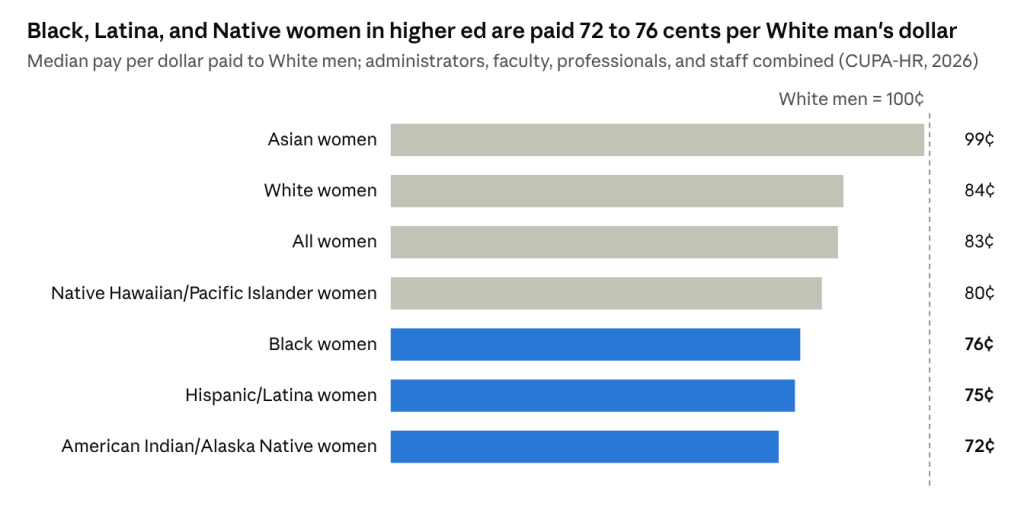
Note. Each bar shows the median pay of women in that group for every dollar paid to White men, with administrators, faculty, professionals, and staff combined. The dashed line marks pay equity with White men (100 cents). Data from C. Williams (2026).
Across the higher education workforce, Black women earn 76 cents, Hispanic/Latina women 75 cents, and American Indian/Alaska Native women 72 cents for every dollar White men earn. Asian women, at 99 cents, are the only group close to equity (C. Williams, 2026).
These figures and the professionals’ finding can both be true because they measure different things. The professionals’ finding compares people within a single job group. Figure 1 combines all groups, so it also reflects which jobs people hold in the first place. People of color make up about one third of staff, the lowest-paid group, but only 21% of administrators, the highest-paid group (CUPA-HR, 2026a, 2026c). Among administrators, every group of women, except Asian women, is still paid less than White men (CUPA-HR, 2026a). Even within staff roles, Black women have been paid 93 cents or less, and Hispanic/Latina women 94 cents or less, for every dollar paid to White men since 2016-17 (CUPA-HR, 2026c).
In other words, achieving equity within one group of jobs does not close the overall gap when access to higher-paying jobs remains unequal. For student affairs, that makes pay a pipeline question as much as a salary question: who gets hired into, promoted into, and retained in the roles that lead to the cabinet.
These gaps shape who stays. In CUPA-HR’s 2025 retention survey, one in four higher education employees said they were likely to look for another job within the year, with better pay cited as the top reason. About 26% of student affairs employees said the same, placing the area among the most at risk. Employees of color were more likely than White employees to be looking (Schneider & Bichsel, 2025). In a 2022 survey of 324 student affairs professionals, only 17% said their salary was competitive, and 37% were actively job hunting. One respondent wrote, “I can go corporate and get paid 30K more and I don’t have to work nights and weekends” (Macmillan Learning, 2022). Many student affairs roles require a master’s degree, yet employers projected 2025 starting salaries of $77,632 for new master’s graduates in business and $94,086 in engineering (Diverse: Issues In Higher Education, 2025).
Paying the people who build the educational environments that produce our society’s next leaders matters, and within our own institutions, the disparities are easy to see. ESPN’s 2018 analysis found that in 39 states, the highest-paid public employee was a college football or basketball coach (Athletic Business, 2018). At large Division I institutions, coaches often earn more than the president and far more than the student affairs staff and faculty entrusted with the educational environment. Those roles are important. So is building institutions that run less on market logic alone and share more of their endowments with the staff hired to support students.
Institutions have practical options. They can conduct regular pay equity audits by race and gender against CUPA-HR benchmarks, post salary ranges in every job listing, compensate for the night and weekend work that defines so many student affairs roles, and fund career ladders so professionals can advance without leaving. In practical terms, pay is the most visible form of appreciation an institution offers. When it falls short, professionals hear that their work is noticed and relied on but not valued.
Research and Expertise
Finally, this field has to compensate people for their intellectual property and research. Institutions shouldn’t use what we create freely and then capitalize on it without credit or our knowledge. That includes the presentation candidates build for interviews. It also means bringing in experts who have researched and led this work to help benchmark your practice and paying them for it rather than discounting their expertise.
Throughout this month, alongside highlighting leaders in student affairs and across our institutions, my consulting company, DrKRWSpeaks, intentionally hosted and promoted professionals whose dissertations, research, and experience have moved the field forward. Hevel (2016) found that research on the history of our own profession remains thin. As a profession still in its infancy compared with American higher education as a whole, we must keep supporting the research and practice so many of us contribute.
Institutions also need to make room for this work within their own walls. That means encouraging faculty and staff to keep conducting research and sharing their expertise with the field, and backing that encouragement with real opportunities: time in their workloads, funding, and support to present and publish. Research from practitioners helps us improve the experiences we offer and understand the needs of the students on our campuses now. It also helps us think strategically about how to prepare students for careers and professions that keep evolving, and how to prepare our institutions for the students of tomorrow.
Conclusion
I entered student affairs to ensure that all students, especially those who looked like me, could persist at whichever institution they chose. Throughout my career as a scholar-practitioner, I have advocated for creating those environments and have offered research and experience showing how we can work together to make that goal a reality. Yet the longer I do this work, the more I am reminded that our historical trauma and the way these spaces were first built are ingrained in the very foundations meant to serve the students on our campuses today.
To do this work effectively, student affairs must own its history and actively dismantle the systems we have been told to operate within. History has taught us that students have always needed and relied on leaders within this system to serve and guide them toward their goals. Those same leaders have to keep pushing our institutions to support not only the students of today but also the students of tomorrow. To do that, we must be prepared to look closely at how intentionally inclusive our institutions are, how we pay our faculty and staff, and how we partner with leaders in this field whose research can continue to improve our campuses. Pay deserves particular attention for our colleagues from historically marginalized and oppressed groups, who carry so much of the weight of cultural support for students. And we have to keep encouraging new research for the students still to come.
Mattering has been at the heart of this profession since before it had a name. Schlossberg’s (1989) five dimensions capture what students have always needed from us and what we need from our institutions. Attention means someone notices you. Importance means someone cares about what you think and want. Ego-extension means someone shares in your successes and feels your setbacks. Dependence means someone needs you. Appreciation means someone values what you give. Students persist when they feel all five. So do the professionals who serve them.
The future of student affairs depends on whether we can offer both. Our students will continue to arrive with new pressures and questions, and they will still ask whether anyone here notices them and would miss them if they left. We can only answer yes if the people doing this work are noticed, paid fairly, credited for their ideas, and supported in staying. We are in a difficult space right now, one that challenges our purpose and our commitment to equity and inclusion. This profession has persevered through hard times before. Just as the field took shape amid the upheaval of the 1800s, we will need leaders who are knowledgeable and prepared to keep trailblazing and building toward where we go next.
To my colleagues: keep doing this work. Keep showing up for the student locked out of their room, the student questioning their identity, and the student who looks like me and needs someone to say they belong. If you feel the pull of this work as I did at Otterbein, join us on this journey. Bring your research and your lived experience. There is a place for you here, and you will matter.
References
ACPA. (n.d.). History of ACPA. https://archive.myacpa.org/history
American Council on Education. (1937). The student personnel point of view (American Council on Education Studies, Series 1, Vol. 1, No. 3).
American Council on Education. (1949). The student personnel point of view (Rev. ed., American Council on Education Studies, Series 6, No. 13).
Athletic Business. (2018). The highest paid public employee in 39 states is a coach. https://www.athleticbusiness.com/operations/programming/news/15154661/the-highest-paid-public-employee-in-39-states-is-a-coach
Civil Rights Act of 1964, Title VI, 42 U.S.C. § 2000d (1964).
Cole, D., Newman, C. B., & Hypolite, L. I. (2020). Sense of belonging and mattering among two cohorts of first-year students participating in a comprehensive college transition program. American Behavioral Scientist, 64(3), 276–297. https://doi.org/10.1177/0002764219869417
CUPA-HR. (2026a, September 1). Administrators composition and pay equity by gender and race/ethnicity. https://www.cupahr.org/resource/administrators-composition-and-pay-equity-by-gender-and-race-ethnicity/
CUPA-HR. (2026b, September 22). Professionals composition and pay equity by gender and race/ethnicity. https://www.cupahr.org/resource/professionals-composition-and-pay-equity-by-gender-and-race-ethnicity/
CUPA-HR. (2026c, September 15). Staff composition and pay equity by gender and race/ethnicity. https://www.cupahr.org/resource/staff-composition-and-pay-equity-by-gender-and-race-ethnicity/
Diverse: Issues In Higher Education. (2025). Class of 2025 salary projections show mixed results despite strong job market. https://www.diverseeducation.com/students/article/15739601/class-of-2025-salary-projections-show-mixed-results-despite-strong-job-market
Elliott, G., Kao, S., & Grant, A.-M. (2004). Mattering: Empirical validation of a social-psychological concept. Self and Identity, 3(4), 339–354. https://doi.org/10.1080/13576500444000119
Foner, E. (1988). Reconstruction: America’s unfinished revolution, 1863–1877. Harper & Row.
Gaston-Gayles, J. L., Wolf-Wendel, L. E., Tuttle, K. N., Twombly, S. B., & Ward, K. (2005). From disciplinarian to change agent: How the civil rights era changed the roles of student affairs professionals. NASPA Journal, 42(3), 263–282. https://doi.org/10.2202/1949-6605.1500
Hevel, M. S. (2016). Toward a history of student affairs: A synthesis of research, 1996–2015. Journal of College Student Development, 57(7), 844–862. https://doi.org/10.1353/csd.2016.0082
Hurtado, S., & Carter, D. F. (1997). Effects of college transition and perceptions of the campus racial climate on Latino college students’ sense of belonging. Sociology of Education, 70(4), 324–345. https://doi.org/10.2307/2673270
Joseph, T. D., & Hirshfield, L. E. (2011). “Why don’t you get somebody new to do it?” Race and cultural taxation in the academy. Ethnic and Racial Studies, 34(1), 121–141. https://doi.org/10.1080/01419870.2010.496489
Jung, A.-K., & Heppner, M. J. (2017). Development and validation of a Work Mattering Scale (WMS). Journal of Career Assessment, 25(3), 467–483. https://doi.org/10.1177/1069072715599412
Kuh, G. D. (2009). What student affairs professionals need to know about student engagement. Journal of College Student Development, 50(6), 683–706. https://doi.org/10.1353/csd.0.0099
Lee, R., & Ahtone, T. (2020, March 30). Land-grab universities. High Country News. https://www.hcn.org/issues/52.4/indigenous-affairs-education-land-grab-universities
Long, D. (2012). The foundations of student affairs: A guide to the profession. In L. J. Hinchliffe & M. A. Wong (Eds.), Environments for student growth and development: Librarians and student affairs in collaboration (pp. 1–39). Association of College & Research Libraries. https://ir.library.illinoisstate.edu/fpml/30
Macmillan Learning. (2022, November 17). Nearly one third of student affairs professionals seeking to leave higher education [Press release]. Business Wire. https://www.businesswire.com/news/home/20221117005138/en/
Marshall, S. M., Gardner, M. M., Hughes, C., & Lowery, U. (2016). Attrition from student affairs: Perspectives from those who exited the profession. Journal of Student Affairs Research and Practice, 53(2), 146–159. https://doi.org/10.1080/19496591.2016.1147359
Mullen, P. R., Malone, A., Denney, A., & Dietz, S. S. (2018). Job stress, burnout, job satisfaction, and turnover intention among student affairs professionals. College Student Affairs Journal, 36(1), 94–108. https://doi.org/10.1353/csj.2018.0006
NASPA. (n.d.). Our history. https://history.naspa.org/
NASPA. (2022). The compass report: Charting the future of student affairs. https://naspa.org/futureofstudentaffairs
Nuss, E. M. (2003). The development of student affairs. In S. R. Komives, D. B. Woodard Jr., & Associates (Eds.), Student services: A handbook for the profession (4th ed., pp. 65–88). Jossey-Bass.
Oberlin College. (n.d.). Oberlin history. https://www.oberlin.edu/node/35791
Otterbein University. (n.d.). William Hannibal Thomas: A complex man and a complex part of Otterbein’s history. https://www.otterbein.edu/news/william-hannibal-thomas-a-complex-man-and-a-complex-part-of-otterbeins-history/
Otterbein University. (2023). 130 years ago, William Henry Fouse took the stage as Otterbein’s first Black graduate. https://www.otterbein.edu/news/130-years-ago-william-henry-fouse-took-the-stage-as-otterbeins-first-black-graduate/
Padilla, A. M. (1994). Ethnic minority scholars, research, and mentoring: Current and future issues. Educational Researcher, 23(4), 24–27. https://doi.org/10.3102/0013189X023004024
Pascarella, E. T., & Terenzini, P. T. (2005). How college affects students: Vol. 2. A third decade of research. Jossey-Bass.
Plessy v. Ferguson, 163 U.S. 537 (1896).
Prilleltensky, I. (2020). Mattering at the intersection of psychology, philosophy, and politics. American Journal of Community Psychology, 65(1–2), 16–34. https://doi.org/10.1002/ajcp.12368
Quaye, S. J., Karikari, S. N., Allen, C. R., Okello, W. K., & Carter, K. D. (2019). Strategies for practicing self-care from racial battle fatigue. Journal Committed to Social Change on Race and Ethnicity, 5(2), 94–131.
Rayle, A. D., & Chung, K.-Y. (2007). Revisiting first-year college students’ mattering: Social support, academic stress, and the mattering experience. Journal of College Student Retention: Research, Theory & Practice, 9(1), 21–37. https://doi.org/10.2190/X126-5606-4G36-8132
Rosenberg, M., & McCullough, B. C. (1981). Mattering: Inferred significance and mental health among adolescents. Research in Community and Mental Health, 2, 163–182.
Rosser, V. J., & Javinar, J. M. (2003). Midlevel student affairs leaders’ intentions to leave: Examining the quality of their professional and institutional work life. Journal of College Student Development, 44(6), 813–830. https://doi.org/10.1353/csd.2003.0076
Schlossberg, N. K. (1989). Marginality and mattering: Key issues in building community. New Directions for Student Services, 1989(48), 5–15. https://doi.org/10.1002/ss.37119894803
Schneider, J., & Bichsel, J. (2025). The CUPA-HR 2025 higher education employee retention survey. CUPA-HR. https://www.cupahr.org/resource/higher-ed-employee-retention-survey-findings-september-2025/
Schuh, J. H., Jones, S. R., & Torres, V. (Eds.). (2017). Student services: A handbook for the profession (6th ed.). Jossey-Bass.
Smith, W. A., Allen, W. R., & Danley, L. L. (2007). “Assume the position . . . you fit the description”: Psychosocial experiences and racial battle fatigue among African American male college students. American Behavioral Scientist, 51(4), 551–578. https://doi.org/10.1177/0002764207307742
Strayhorn, T. L. (2019). College students’ sense of belonging: A key to educational success for all students (2nd ed.). Routledge.
Sweet, J. (2026, April 29). Harvard deepens commitment to HBCUs with $1.05 million grant. The Harvard Gazette. https://news.harvard.edu/gazette/story/2026/04/harvard-deepens-commitment-to-hbcus-with-1-05-million-grant/
Tierney, W. G. (1992). An anthropological analysis of student participation in college. The Journal of Higher Education, 63(6), 603–618. https://doi.org/10.2307/1982046
Williams, C. (2026, March 4). Higher ed Equal Pay Day 2026: Women are paid 83 cents on the dollar. CUPA-HR. https://www.cupahr.org/resource/higher-ed-equal-pay-day-2026-women-are-paid-83-cents-on-the-dollar/
Williams, K. R. (2018). Influence of mattering on Black males’ intent to persist at a regional predominantly White institution [Doctoral dissertation, Texas A&M University-Commerce]. ProQuest Dissertations and Theses Global.


Leave a Reply